TSMC Strengthens the Local Semiconductor Assembly and Test Supply Chain, Achieving a Win-Win in Efficiency and Resilience
Supporting Electroplating Additive Suppliers to Establish Factories in Taiwan, Reducing Production Cycle by 66%

As the rapid development of AI technology drives continuous growth in global semiconductor demand, TSMC is actively advancing its localization strategy to ensure a stable supply of electroplating additives—key chemicals used in advanced packaging processes. Through four key initiatives—production line guidance, equipment optimization, quality inspection, and sample verification—TSMC successfully assisted a Japanese supplier in setting up a factory in Taiwan. This effort reduced the production cycle from 60 days to 20 days and increased transportation efficiency by 90%. In January 2026, the locally produced electroplating additives were introduced at TSMC’s Advanced Backend Fab 2 and are expected to be fully deployed across Advanced Backend Fabs 3, 5, 6, and 8 by the end of the first quarter. This initiative not only strengthens supply chain resilience but also injects fresh momentum into the sustainable growth of Taiwan's semiconductor industry ecosystem.
.png)
By leveraging TSMC's Best Known Method (BKM), suppliers are guided to optimize factory construction, raw material control, process automation, chemical filling, and outbound inspection. This ensures full compliance with semiconductor process requirements
.png)
Through on-site audits and technical exchanges, TSMC enhances production quality and optimizes equipment performance. Also, source management is implemented to ensure compliance with the evolving requirements of high-end packaging technologies, thereby strengthening product stability and system reliability
.png)
Suppliers are required to commission a third-party organization to conduct finished product testing. Using advanced techniques such as Inductively Coupled Plasma Optical Emission Spectrometry (ICP-OES) and acid-base titration, it is verified that the products are free from anomalous functional groups or impurity residues

After passing quality inspections, finished products are introduced into advanced packaging processes for phased validation, scaling from small to large production volumes. This ensures that the products meet TSMC's production requirements, achieving the dual goals of both capacity and quality
Electroplating additives are essential chemicals that enable the precise formation of key metallic structures on semiconductor chips. Historically, the supply of these activities has heavily relied on overseas imports. TSMC is committed to advancing the development of local supply chains. After successfully localizing the production of electroplating solutions, the Corporate Analytical Laboratories and the Materials Management Organization proposed that suppliers establish electroplating additive production facilities in Taiwan. This initiative aims to enhance supply efficiency and strengthen the competitiveness of the semiconductor industry. To ensure the smooth setup of production facilities and compliance with process specifications, TSMC has built a comprehensive local supply system. This effort has successfully reduced production cycle by 66% and lowered the carbon footprint associated with overseas transportation. Furthermore, by working directly with the supplier's local factory, information processing efficiency has improved by 98%, effectively strengthening bilateral cooperation and optimizing operational performance.
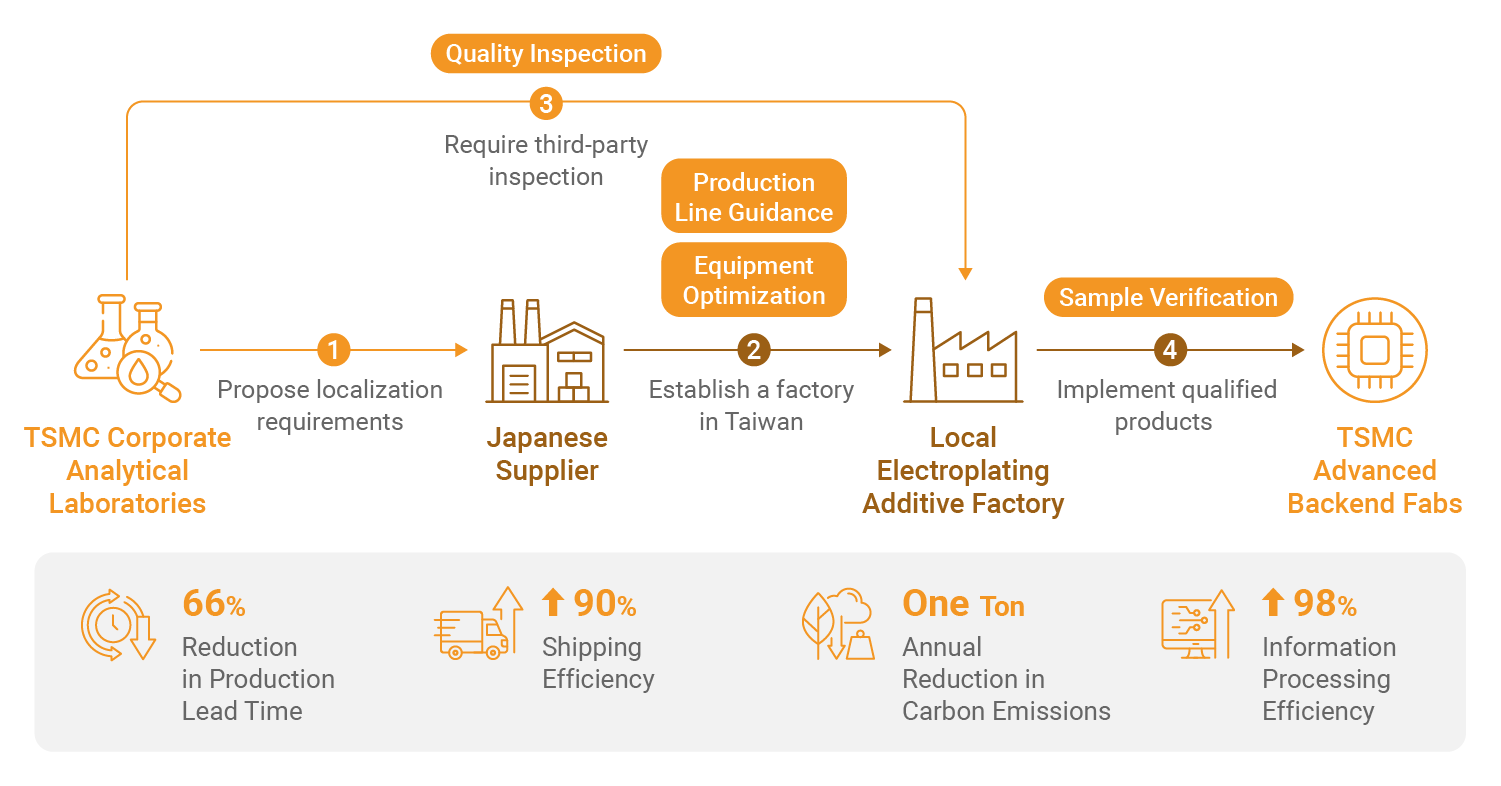
TSMC deepens local supply chain development, enhancing product quality and transportation efficiency while also considering cost-effectiveness, achieving a win-win-win for all parties.
TSMC considers the establishment of a local supply chain as a key strategy for sustainable operations and continues to drive the localization of chemical production. The Company plans to collaborate with suppliers to complete the construction of a copper electroplating additive production line by March 2026. This initiative aims to ensure the stable supply of critical materials, mitigate operational risks, deepen the practice of a responsible supply chain, and foster shared prosperity within the industry.
Stay Connected
Subscribe to our newsletter for the latest updates and explore sustainability with us.
This site is protected by reCAPTCHA and the Google Privacy Policy and Terms of Service apply.