TSMC's "Waste Sulfuric Acid Reclaim System 2.0" : Win-win in Conservation and Performance

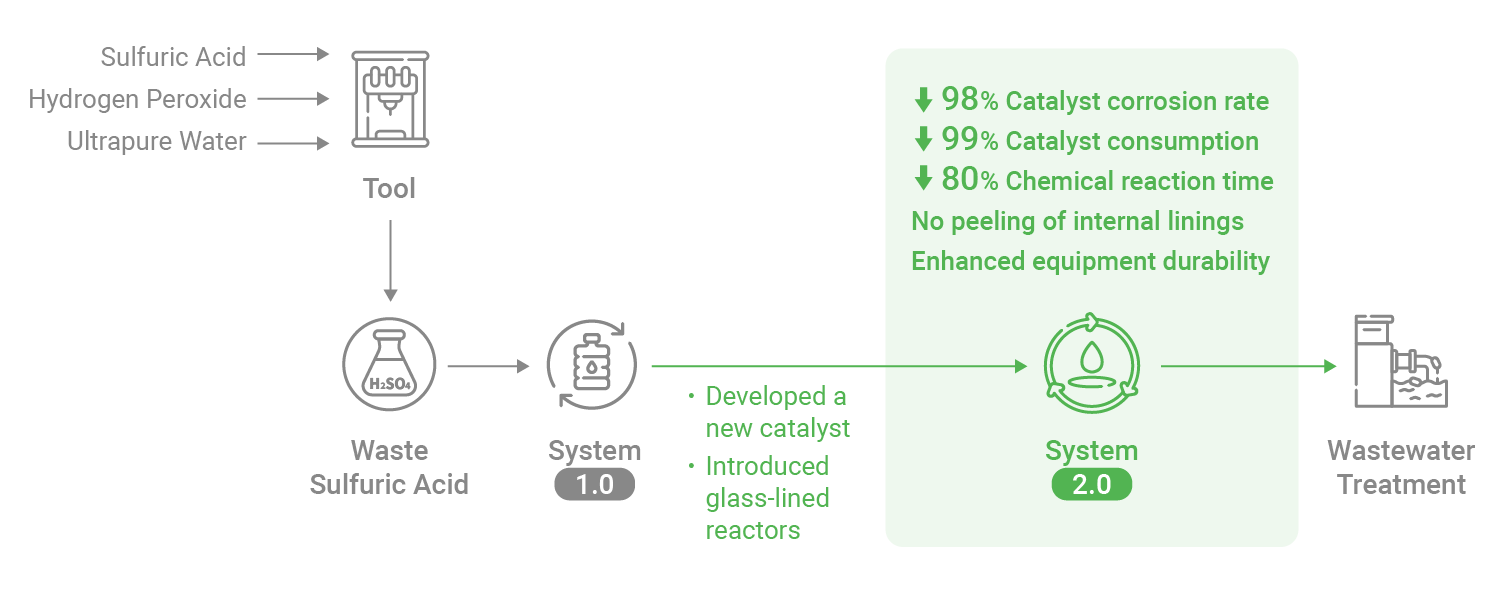
TSMC is actively building a green ecosystem to support circular economy. Following the launch of its pioneering Waste Sulfuric Acid Reclaim System 1.0, which achieved zero purchase of industrial-grade sulfuric acid, the Company has further developed a new catalyst and introduced high-temperature and corrosion-resistant glass-lined reactors. These innovations overcome issues including equipment corrosion and peeling of reactor linings after years of operation, and led to a comprehensive upgrade to "Waste Sulfuric Acid Reclaim System 2.0." The system was installed at Fab 15B in 2024 and has been verified after completing one year of actual operation, demonstrating significant performance improvements: the new catalyst reduced the corrosion rate of stainless steel equipment by 98%, decreased catalyst consumption by 99%, and shortened chemical reaction time by over 80%. The glass-lined reactors effectively prevent the peeling of internal linings, enhancing equipment durability. As of 2025, the Waste Sulfuric Acid Reclaim System 2.0 has been incorporated into the standard design for new fabs, further expanding the value of material regeneration.
Breaking through Technical Challenges for the Next Evolution of the Reclaim System
Sulfuric acid is a crucial chemical in semiconductor manufacturing processes. TSMC is committed to resource recycling and reuse, and in 2014, the Company developed the Waste Sulfuric Acid Reclaim System 1.0, which enabled the regeneration of waste sulfuric acid into industrial-grade sulfuric acid for reuse in the in-house wastewater treatment system. To address the technical challenges arising from the system's long-term operation, TSMC conducted in-depth research into the chemical reactions within the reclaim system. This led to the development of a new catalyst, replacing hydrochloric acid as the raw material for the catalyst. Through a combination of design of experiments (DOE) and multi-level testing, a novel low-corrosive catalyst was developed. This not only reduced the risk of equipment wear and tear but also decreased catalyst consumption due to enhanced catalytic effects which accelerated the chemical reaction process. Furthermore, by introducing glass-lined reactor technology, an enamel layer formed by high-temperature sintering covers the interior of the tank. This replaces the traditional design of fixing lining materials with adhesives, effectively preventing inner linings from peeling due to adhesive failure in high-temperature environments, strengthening equipment durability and ensuring stable operation.
TSMC aims to achieve "zero off-site sulfuric acid disposal." In addition to upgrading its in-house waste sulfuric acid reclaim system, the Company also plans to transform waste sulfuric acid into high-value-added derivative products through its Zero Waste Manufacturing Center. These products will find applications in industrial raw materials, construction materials, and other sectors, reducing the environmental impact of discarded resources. This initiative embodies TSMC's commitment to the circular economy and sustainable development, marking a new milestone in zero-waste manufacturing.
Stay Connected
Subscribe to our newsletter for the latest updates and explore sustainability with us.
This site is protected by reCAPTCHA and the Google Privacy Policy and Terms of Service apply.