
To improve product quality, TSMC prioritizes sustainable chemical management as a key strategy, aiming to eliminate hazardous chemicals such as Per- and Polyfluoroalkyl Substances (PFAS) from all processes to meet its sustainability goals. The Company has established four major management strategies: source control, industry cooperation, environment monitoring, and pollution control, and it discloses its annual progress in sustainability reports. In response to increasing international concerns about PFAS, TSMC has continuously optimized its PFAS detection capabilities. By implementing filtration-direct analysis, the Company has reduced the detection process time from 105 minutes to 15 minutes, improving efficiency by 86% while minimizing contamination risks. This method has been verified for reliability by the American third-party testing organization Eurofins, with detection data recognized by the U.S. Environmental Protection Agency (USEPA). As of March 2025, this method has been implemented in all domestic and overseas 12-inch, 8-inch, and backend fabs, further bolstering environmental, safety, and health management.
TSMC’s Strategy for Managing PFAS
| Strategies | Description |
|---|---|
| Source Control |
|
| Industry Cooperation |
|
| Environment Monitoring |
|
| Pollution Control |
|
Methodology Verification and Third-Party Validation for Reliable Detection
PFAS refer to all perfluoroalkyl and polyfluoroalkyl substances, known for their water, oil, stain, and heat-resistant properties, leading to their widespread use in industrial manufacturing and consumer products. Due to their stable chemical nature, PFAS can persist in the environment for prolonged periods, with carbon-fluorine chain length impacting solubility and volatility, leading to bioaccumulation and ecological toxicity. In response, many countries are gradually implementing regulations to control their use. TSMC has established PFAS treatment systems at each plant and developed testing technologies to routinely monitor PFAS concentrations in effluent. Recognizing the time-consuming and error-prone sample adsorption and desorption steps in Solid Phase Extraction (SPE), TSMC's facility laboratory has improved the PFAS analysis process. By filtering and directly analyzing samples with liquid chromatography-tandem mass spectrometry (LC-MS/MS), they have enhanced both efficiency and analysis quality.
To ensure the efficacy of the new testing process, the facility laboratory conducted stability experiments involving both short-term, same-day tests and long-term, cross-day tests on identical samples. The results demonstrated that the error range was maintained within ±10%, surpassing the USEPA standard of ±20%. Additionally, in recovery rate tests, the recovery rate for additives at the parts-per-trillion (ppt) concentration level was controlled within 100 ± 20%, also exceeding the USEPA standard of 100±30%. To further validate the reliability of this testing method, the facility laboratory collaborated with Eurofins, a third-party analytical company, to perform comparative measurements on the same samples. The findings revealed that both the filtration-direct analysis method and the solid-phase extraction method used by Eurofins yielded consistent concentration measurement trends at the parts-per-billion (ppb) concentration level, achieving a high coefficient of determination (R2) greater than 0.96. This methodology has been successfully applied to the detection of PFAS.
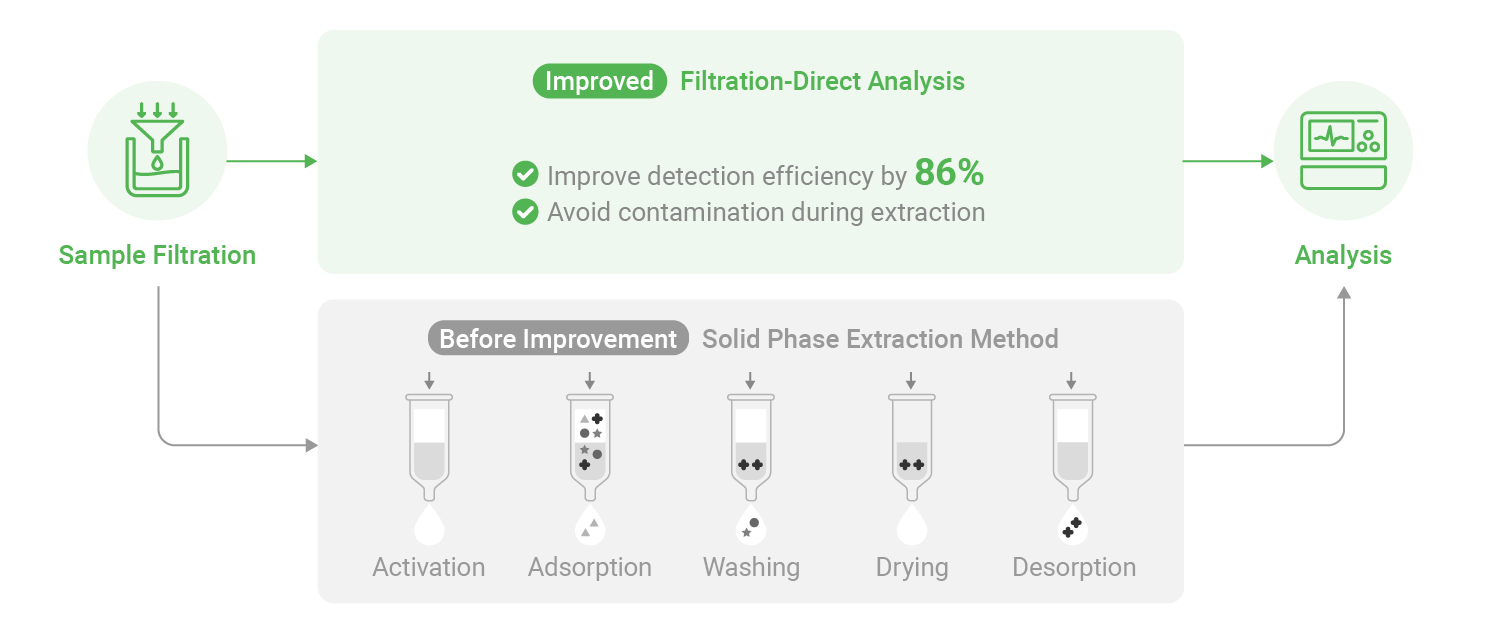
TSMC is improving PFAS detection efficiency through filtration-direct analysis and is also exploring the integration of liquid chromatography-tandem mass spectrometry (LC-MS/MS) with wastewater system systems. This initiative aims to establish an online continuous inspection method, enabling faster identification and management of wastewater quality using real-time data. Additionally, TSMC is actively developing analytical technologies for detecting PFAS in gaseous samples, which are instrumental in air pollution detection. This comprehensive approach to manage potential PFAS emissions not only boosts industrial safety but also supports sustainable environmental development. These efforts underscore TSMC's dedication to responsible operational practices.
Stay Connected
Subscribe to our newsletter for the latest updates and explore sustainability with us.
This site is protected by reCAPTCHA and the Google Privacy Policy and Terms of Service apply.