TSMC's "Lithium Iron Battery Generation Upgrade Project": Next-Level Safety for 408,000 Batteries

TSMC is committed to improving sustainability risk management. The Company is gradually replacing lead-acid batteries with lithium iron batteries in uninterruptible power supply (UPS) systems for new and existing fabs to save energy and achieve other environmental benefits. For this project, TSMC partnered with suppliers and internal and external experts to launch the "Lithium Iron Battery Generation Upgrade Project." This initiative aims to further strengthen operational environmental safety and battery energy management. The project involves inventorying and optimizing approximately 408,000 lithium iron batteries across domestic and international fabs, and validating battery safety performance as well as the effectiveness of Battery Management System (BMS) protection through Thermal Runaway experiments. By Q1 2026, first and second-generation lithium iron battery management systems were successfully upgraded entirely to the third generation. This new system can precisely detect voltage, state of charge, current, temperature, and state of health, and instantly transmit this data back to the fab's Supervisory Control and Data Acquisition (SCADA) system, improving energy storage safety and management efficiency.
Advancing Intelligent Safety Management with Three Generations of Evolution
Lithium iron batteries, with their high energy saving, long cycle life, and environmentally friendly characteristics, have become crucial components for stable UPS operation and optimized energy efficiency. After completing in-fab production line verification in 2017, TSMC began using first-generation lithium iron batteries. These were monitored for voltage via sampling boards to ensure system operational safety. In response to the International Electrotechnical Commission's IEC 62619 Safety Requirements for Secondary Lithium Cells and Batteries industrial applications, TSMC adopted second-generation lithium iron batteries in 2018. The BMS (Battery Management System) in these batteries added monitoring functions for state of charge, temperature, and state of health in addition to voltage, improving the monitoring of battery status.
To deepen its continuous investment in battery technology and comply with the NFPA 855 Standard for the Installation of Stationary Energy Storage Systems published by the National Fire Protection Association (NFPA), TSMC began research into third-generation lithium iron battery applications with suppliers in 2019. The third-generation BMS is able to monitor critical parameters such as voltage, state of charge, current, temperature, and state of health. It also integrates with the factory's SCADA system, enabling real-time data transmission and remote diagnosis. If abnormality occurred, it can identify fault point immediately, which improves the efficiency of handling emergency responses by 25%. Furthermore, in 2024, thermal runaway experiments were conducted on the lithium iron batteries to verify their safety performance under extreme conditions, laying a reliable foundation for upgrading existing systems.
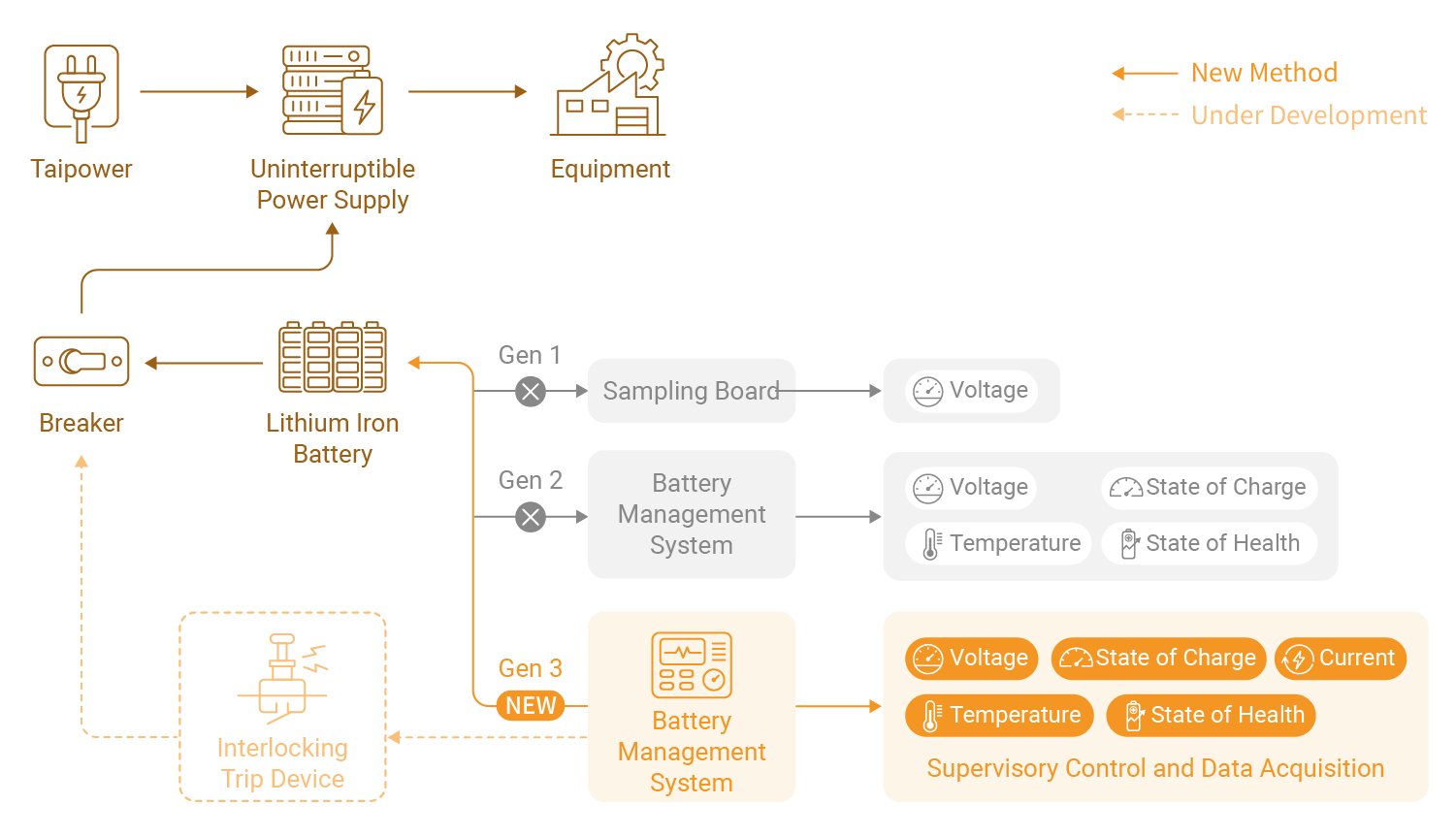
While comprehensively upgrading the lithium iron battery management system to the third generation, TSMC also developed a lithium iron battery breaker interlocking trip device. This device can automatically cut off the lithium iron battery's power supply when the BMS detects a battery anomaly, preventing potential hazards and improving system operational safety. The installation of these trip devices is expected to be completed by 2027, demonstrating a commitment to the highest standards of battery safety.
- Adopted first-generation lithium iron batteries, and began the replacement of lead-acid batteries in fabs
- Upgraded to second-generation lithium iron batteries, with the BMS integrating monitoring for voltage, state of charge, temperature, and state of health
- Adopted third-generation lithium iron batteries, with the BMS adding current monitoring and integration with the SCADA system to achieve real-time data transmission and remote diagnosis
- Conducted inventory and optimization of 408,000 lithium iron batteries and verified battery performance and BMS protection through thermal runaway experiments
- Comprehensively upgraded the first and second-generation lithium iron battery management systems to the third-generation standard
- Aim to complete the installation of 408,000 lithium iron battery breaker trip devices, enhancing system operational safety
Stay Connected
Subscribe to our newsletter for the latest updates and explore sustainability with us.
This site is protected by reCAPTCHA and the Google Privacy Policy and Terms of Service apply.