TSMC's Chemical Waste Reuse Creates a New Model for Circular Economy
Recycling Electronic-grade Organic Solvents is Expected to Reduce Carbon Emissions by over 30,000 Metric Tons Annually

TSMC is committed to establishing green systems of circular economy. Through its "Electronic-Grade Chemical Recycling Program," it has successfully recycled and reused chemicals such as Isopropanol (IPA), Tetramethyl Ammonium Hydroxide (TMAH), and Cyclopentanone within its facilities. In 2025, the Company further collaborated with suppliers to develop waste liquid reuse technology for Propylene Glycol Monomethyl Ether (PGME) and Propylene Glycol Monomethyl Ether Acetate (PGMEA), widely used organic solvents in the photolithography process. Utilizing three key operational procedures—"source segregation management, process parameter optimization, and component spectral comparison"—the waste liquids are reprocessed into electronic-grade PGME/PGMEA that meets TSMC's quality specifications. In January 2026, this technology was successfully validated at Fab 15B and Fab 18A and is scheduled for implementation at Fab 14B, Fab 15A, Fab 15B, Fab 18A, and Fab 18B in Q2 2026. After full implementation, it is expected to reduce new liquid procurement by 16,000 metric tons annually and cut carbon emissions by 31,100 metric tons, realizing the value of cradle-to-cradle resource circularity.
Waste Solvent Transforms into High-purity Raw Materials: A Breakthrough in Recycling Technology
PGME/PGMEA are primarily used in the semiconductor photolithography process, typically as a mixed solvent for chip cleaning, photoresist dilution, and equipment cleaning. Previously, spent liquids were often resold to industrial markets such as coatings, inks, and textiles after initial separation of water and solids. As advanced processes evolve, the demand for PGME/PGMEA continues to increase. TSMC has partnered with suppliers to actively invest in waste liquid recycling and regeneration technologies and process optimization, creating a model for circular reuse of chemicals. First, addressing the challenge that differences in boiling points among various solvents in waste liquids can affect recovery and separation efficiency, as well as the purity of electronic-grade materials, TSMC collaborated with suppliers to establish a waste liquid source management mechanism to precisely segregate liquids of different purities. Second, by adjusting distillation column process parameters, organic impurities and metal ions are effectively removed, ensuring high-purity recovered raw materials and further improving esterification reaction yield. Furthermore, to ensure that recycled PGME/PGMEA meets electronic-grade standards, suppliers must perform organic component spectral comparisons before shipment to ensure their performance and reliability meet semiconductor manufacturing requirements, ensuring both product quality and manufacturing stability.
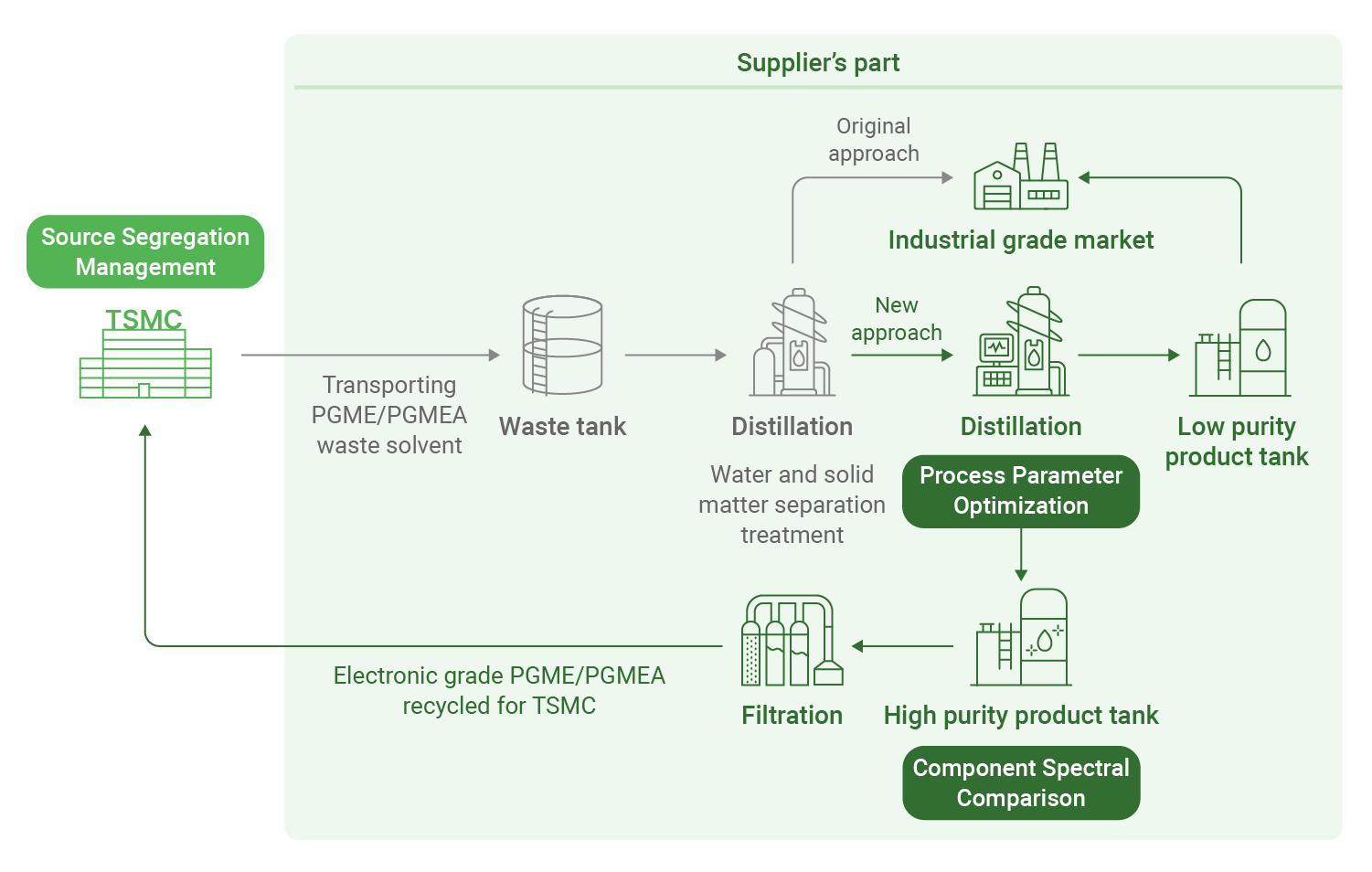
TSMC, upholding its philosophy as "a Practitioner of Green Power," actively responds to the Unites Nation's 12th Sustainable Development Goal—Responsible Consumption and Production. The company continuously collaborates with suppliers to develop purification technologies for a wide variety of chemical waste liquids. In addition to PGME/PGMEA, feasibility assessments are also underway for the reuse of n-Butyl Acetate (NBAC) and Hydrofluoric Acid (HF). The aim is to achieve highly efficient waste liquid recovery and the mass production of electronic-grade recycled materials and set new benchmarks for sustainable manufacturing.
Stay Connected
Subscribe to our newsletter for the latest updates and explore sustainability with us.
This site is protected by reCAPTCHA and the Google Privacy Policy and Terms of Service apply.