
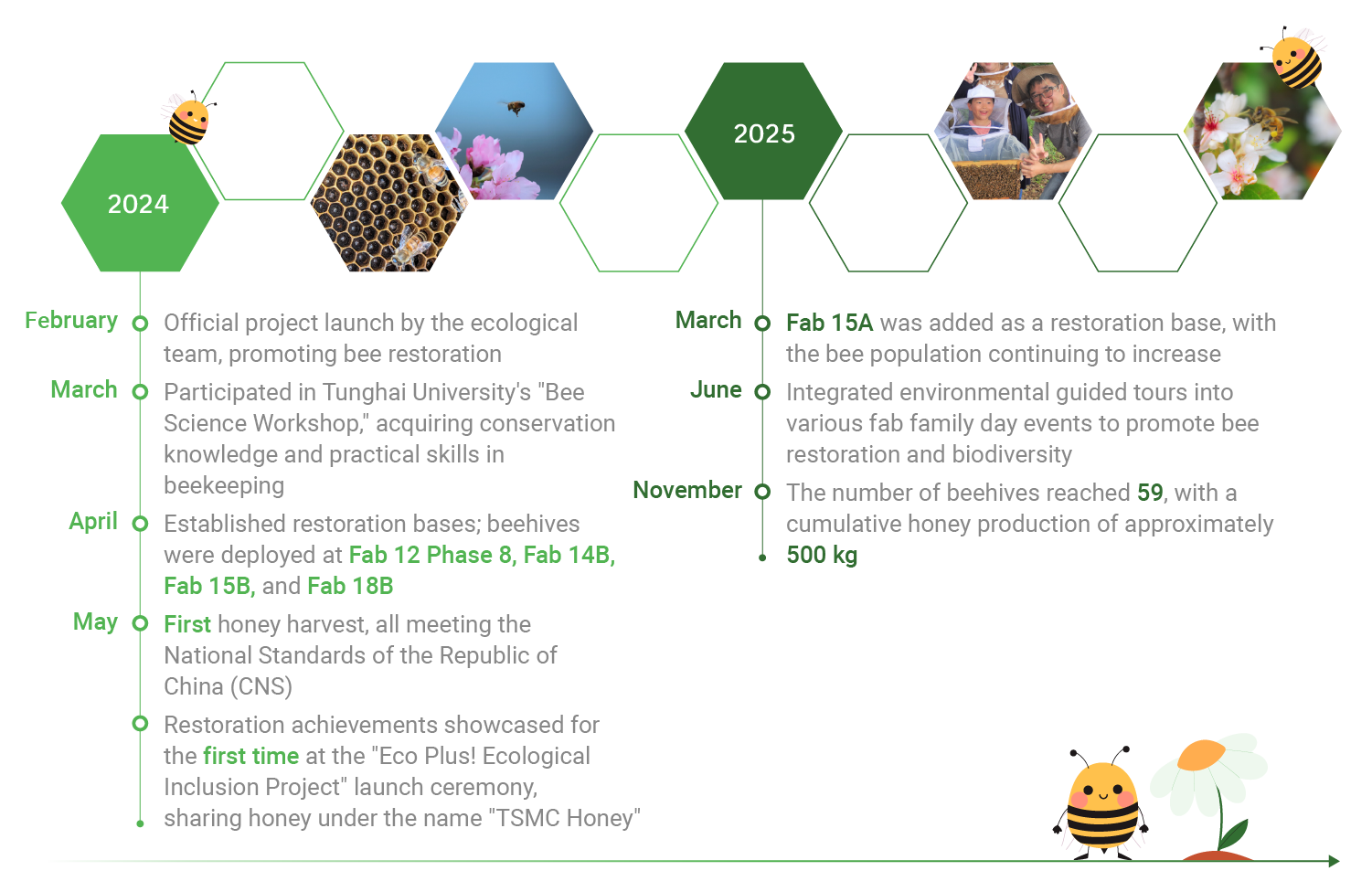
TSMC actively promotes a balance between technology and ecology, and is the first company in Taiwan to successfully restore firefly and Taiwan gudgeon (Squalidus banarescui) populations within its factory campuses. To foster the development of a sustainable ecosystem and conserve biodiversity, TSMC launched the "TSMC Honey Project," to restore habitats for bees, crucial pollinators for plant propagation. This initiative involves collaboration with Tunghai University's Department of Life Sciences and local beekeepers from the Hsinchu, Taichung, and Tainan areas. Restoration bases have been established at Fab 12 Phase 8, Fab 14B, Fab 15A, Fab 15B, and Fab 18B. TSMC is also promoting environmental education through family day events across various fabs to build a deeper understanding of ecological conservation. As of November 2025, 59 beehives have nurtured approximately 1.18 million bees, yielding a cumulative total of about 500 kg of honey. Fourteen environmental education sessions have been conducted, attracting 6,052 participants, embodying the spirit of common good between business operations and the natural environment.
Beehives Established at Restoration Bases to Protect Biodiversity in Fab Areas
Bees are a crucial species for maintaining ecological balance; their pollination supports approximately three-quarters of global crop production, making them vital for human food security and ecological stability. TSMC is committed to transforming its fab campuses into environmentally friendly biological habitats. To protect bees from harm caused by nesting in facilities around the fabs and to improve operational safety, the "TSMC Honey Project" was launched in February 2024. This initiative invited the Department of Life Sciences at Tunghai University to host a "Bee Science Workshop," helping TSMC's ecological team systematically learn about bee conservation knowledge and practices. Beehives were then established at the restoration bases within the fabs, incorporating the professional beekeeping experience of local beekeepers to effectively boost bee population growth. In May 2024, the first batch of honey was harvested, meeting the National Standards of the Republic of China (CNS). Furthermore, through fab tour activities during family days, employees and their families are introduced to the structure, types, and habitats of bees, helping them to understand the value of bees to the ecosystem.
Because bees continuously collect nectar during the day, with a flight radius of up to about two kilometers, and are highly sensitive to environmental changes, the health and population fluctuations of their colonies can serve as an early warning indicator for environmental monitoring. TSMC also sends honey produced by bees in the fab areas to Tunghai University for analysis, further validating environmental quality and strengthening testing effectiveness.
In response to the United Nations Sustainable Development Goal (SDG) 15, "Protect, restore and promote sustainable use of terrestrial ecosystems, sustainably manage forests, combat desertification, and halt and reverse land degradation and halt biodiversity loss," TSMC will continue to deepen the "TSMC Honey Project." This includes planning for real-time monitoring of bee populations and feasibility studies on bee-pollinated plant species. Through these tangible actions, TSMC aims to demonstrate the multifaceted value of biodiversity, strengthen ecological conservation capabilities, and achieve harmony between green manufacturing and the natural environment.
Stay Connected
Subscribe to our newsletter for the latest updates and explore sustainability with us.
This site is protected by reCAPTCHA and the Google Privacy Policy and Terms of Service apply.