TSMC Pioneers Recycling of Waste Aluminum-Plastic Packaging Bags, Cutting Carbon Emissions by Over 3,200 Tons Annually
Striving for a 100% Plastic Recycling Rate by 2030, Advancing Toward a Zero-Plastic Future

In alignment with the United Nations Sustainable Development Goal 12─Responsible Consumption and Production─TSMC is committed to building a comprehensive circular economy production model through its outsourced waste resource recycling program, known as the “Rebirth Action” initiative. The Company aims to achieve a 100% waste recycling rate by 2030, with progress disclosed in its annual sustainability reports. To enhance resource recycling efficiency, TSMC has launched the “Aluminum Reimagined” project, which focuses on recycling waste aluminum-plastic packaging bags. This project, recognized with the TSMC ESG AWARD, involves collaboration with suppliers to develop a treatment technology that completely separates the aluminum foil layer from plastic. This process generates approximately 0.1 tons of aluminum with over 75% purity and 0.9 tons of recycled plastic pellets per ton of waste aluminum-plastic packaging bags. These materials can be used to manufacture items like bicycle frames and pedals. In December 2024, TSMC sites in the Southern Taiwan Science Park received approval for recycling and reuse from the Park’s Bureau. By 2025, all TSMC facilities in Taiwan are expected to implement this recycling program, reducing incineration by 1,350 tons and cutting carbon emissions by 3,213 tons annually. This initiative also saves NT$5 million in waste disposal costs, creating new value to resource utilization through green innovation.
Developing Aluminum-plastic Separation and Recycling Technology Revitalizes Discarded Packaging Bags
To meet the diverse needs of anti-static, moisture resistance, and light protection, aluminum-plastic packaging bags for semiconductor wafers are crafted from a complex assembly of more than five bonded materials. The aluminum foil layer poses significant challenges for separation, which has traditionally led to the incineration of used packaging bags. In 2022, TSMC, committed to minimizing waste, maximizing resource recycling, and optimizing supplier management, collaborated with suppliers to pioneer research into recycling and regenerating these waste bags. This research focused on four major aspects: the physical properties of the packaging , separation and regeneration technologies, specifications for recycled products, and sales channels. Initially, the bags are crushed to a specific particle size, and a screw rotates at a constant speed to advance the material for uniform heating. By leveraging the melting point difference between aluminum foil and plastic, extensive experiments were conducted to determine the optimal temperature for effective separation. When the plastic reaches its melting point while the aluminum foil remains solid, centrifugal equipment and screens successfully separate the two components. The melted plastic is subsequently formed into blocks, further crushed, and subjected to injection molding to produce recycled plastic pellets. Meanwhile, the unmelted aluminum foil is processed into aluminum material through extrusion, achieving the dual benefits of reducing incineration and fostering resource regeneration. Throughout the experimental process, the incineration of three tons of waste aluminum-plastic packaging bags was avoided, resulting in a carbon reduction of 7,140 kilograms.
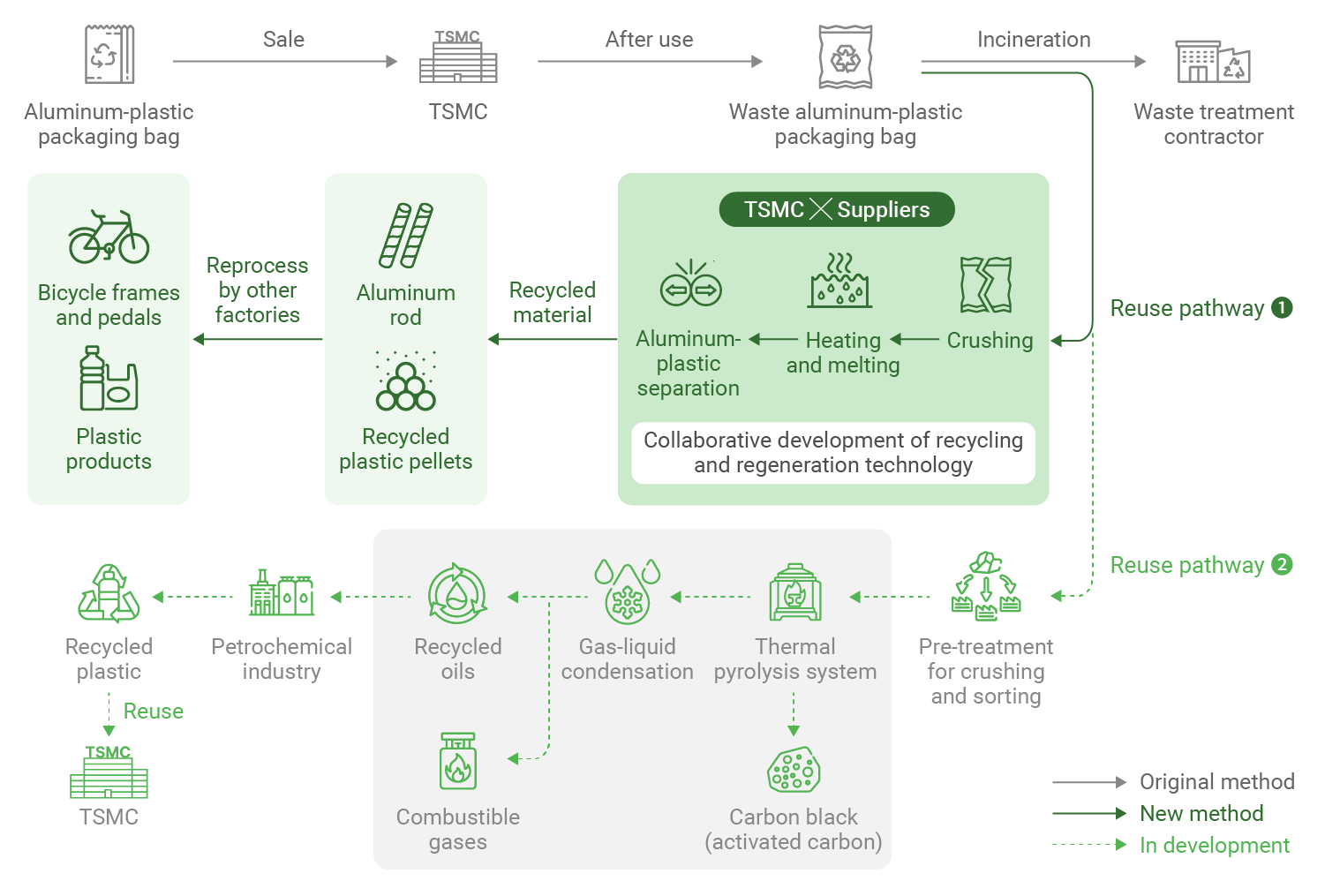
Promoting a circular economy is a key strategy for TSMC in advancing green manufacturing. In addition to recycling and reusing waste aluminum-plastic packaging bags, TSMC is actively exploring diverse pathways for recycling and regeneration. The Company is working with suppliers to assess the conversion of waste plastics through high-temperature pyrolysis into high-value recycled oils, combustible gases, and activated carbon. The recycled oil is expected to be reprocessed into plastic products for reuse within TSMC, establishing a circular regeneration system. The goal is to achieve a 100% plastic recycling rate by 2030, paving the way toward a sustainable, zero-plastic future.
Execution Timeline and Outcomes of the Outsourced Waste Resource Recycling Program: Rebirth Action Initiative
- Launched the Outsourced Waste Resource Recycling program─Rebirth Action
- Recycled cleanroom garment bags into 100% recycled garbage bags for reuse at TSMC
- Reused waste plastic filters as solid recovered fuel to support cogeneration plants, reducing coal usage
- Transformed waste aluminum-plastic packaging bags into bicycles and other plastic products
- Plan to convert waste plastics through high-temperature pyrolysis into high-value recycled oils, combustible gases, and activated carbon
- Aim to achieve a 100% plastic recycling rate
Stay Connected
Subscribe to our newsletter for the latest updates and explore sustainability with us.
This site is protected by reCAPTCHA and the Google Privacy Policy and Terms of Service apply.